-----BEGIN PGP SIGNED MESSAGE-----
Hash: SHA512
Earlier this year, the UK government decided to pass the Online Safety Act; A decision which, to this day, even among some boomers, has been as welcome as a floater in a hot tub. Taking aside the clear and distinct government overreach all in the name of “protecting the kids”, the decision was almost entirely ineffectual - The perfect storm of YouTube sponsors and region-locked streaming services has made it that any GenZ worth their salt is not only aware of VPN’s, most already had one. Just as a crackhead will find copper to fund hes addict, just as a horny teen will download a shady remote access app to circumvent porn blocks. This is so much the case that interest in VPNs across several platforms spiked by close to 150% within weeks of the act passing [1]. Setting aside the steadfast nature of certain platforms (e.g., [4chan][https://4chan.org]) fighting this, it has proven that OFCOM are not holding the aces, but their own proverbial member, with nowt to do with it.
What is a government to do when their imbecilic policies prove to be ineffectual at best?
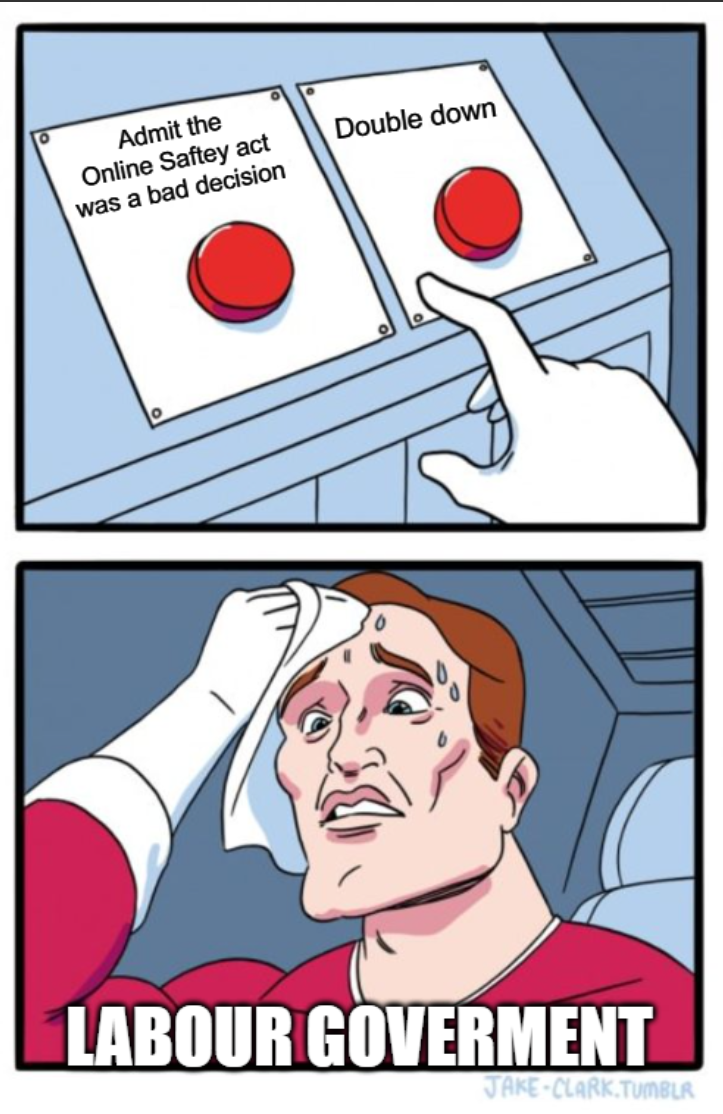
Incredibly quickly after this policy began to glow from the collective idiocy that fed it, murmurs began to emerge that the UK will ban VPN’s. Across the landscape of techies there was a gentle chuckle, all of us thinking “I would love to see you try”. The shill vending platforms could cave, but not all of them (looking at Mullvad). Even if they caved, we could just host our own, right? right?
## The $5 VPS delusion
All governments are the same, and they all trend towards authoritarianism on a long enough timeline. It is an established playbook that when a government's brand-new censorship legislation is as leak-proof as a chicken-wire umbrella, it does not back off. It escalated. It leans on domestic ISPs, threatening `DNS` blocks, blacklisting commercial VPN endpoints, and eyeballing Deep Packet Inspection - The kind of aggressive middlebox infrastructure pioneered by the Great Firewall of China and Rokomnadzor.
Almost on cue, every single Network Chuck fan who once spun up a $5 Linode VPS all began to chime in - as if their five `POSIX` commands they have committed to memory make them a network guru:
> “Bro, just buy a $5 VPS on DigitalOcean, run `algo` or a 1-click WireGuard script, and route your traffic through that. Own the IP, so they can't block you!”
Yeah, okay, buddy.
Renting a virtual server from an AWS reseller with some LTC you bought in 2020 is not the black-hack tradecraft you think it is. You have not outsmarted a multi-million-pound state surveillance apparatus; you have just moved your cleartext signature onto a server whose IP range is registered in a public `ARIN`/`RIPE` database as a commercial datacenter.
Here is why your homebrew VPN provider gets BTFO’d the moment the government turns on DPI

### 1) Wireguard is Loud, Dumb, and Unobfuscated
Wireguard is the best-girl of VPN protocols, and I will not have any slander besmirching its name. Truly seeing this take off and becoming the de facto VPN protocol has been a blessing to see, but this does not change how much it sucks ass as a censorship circumvention tool.
* A WireGuard handshake has a distinct and obvious initiation packet, containing an exact, static length of 148 bytes.
* Every packet starts with a distinct four-byte header sequence (`0x01` type identifier)
* It runs over `UDP` with fixed port characteristics and zero native packet padding.
It is the equivalent of playing Alien Isolation, and your girlfriend walks in shouting, causing your mic to alert the xenomorph to the exact locker you are pissing yourself in. Any middlebox filtering firewall doesn’t need to decrypt your packet to know it is WireGuard. It takes a DPI hardware application less than 3ms to match that initial 148-byte `UDP` packet layout and immediately drop all subsequent traffic to your VPS and send the Stazi to your front door.
### 2) OpenVPN is a Walking Signature
If WireGuard is you hiding in a locker and your girlfriend alerting the Xenomorph, OpenVPN is you sprinting around with a flare and a shotgun singing Cotton Eye’d Joe. Its `TLS` control channel handshake sends identifiable headers in cleartext, uses predictable packet length patterns, and relies on `TLS` certificates that lack proper `SNI` masking. State firewalls have had OpenVPN signatures mapped out since 2012.
### 3) High-Entropy random noise flags you instantly
> “Fine, I'll just wrap my traffic in Shadowsocks to make it look like random garbage”
Smart, but you missed the boat on Shadowsocks- it was made for this exact purpose in China to break past the Great Chinese Firewall… But it has one big issue. It would be like wearing a clown outfit and hoping no one notices you. This is called the entropy trap.
The modern DPI firewall traffic falls into three buckets.
1. Known plain/encrypted protocols: `websockets`, `HTTPS`, `SSH`, `DoH`
2. Recognised VPN protocols: Wireguard, OpenVPN, IPsec
3. Pure, high-entropy “random” noise: Obfuscated traffic with no identifiable framing
Modern DPI state firewalls (like Russia’s TSPU or China’s GFW) use statistical distribution checks. If a stream of packets on port `443` looks like pure, uniform random numbers without the expected `TLS 1.3` frame headers, record sizes, and `ClientHello` patterns, it gets flagged and dropped automatically.
Bypassing modern censorship isn’t an encryption problem. It’s an entropy and behavioral mimicry problem. If your traffic doesn’t look 100% identical to a legitimate web user opening a tab to Google, Microsoft, or Apple, your $5 VPS is dead in the water.
*Also, for the record, I know I wrote down IPsec as an internet protocol - me skipping it doesn’t mean it is the silver bullet and I am choosing to ignore it to prove my point. It means it's not even worth mentioning.*
## Bypassing DPI: The Threat Model Has Changed
> “If neither encryption nor entropy save me, how do I actually bypass state-level censorship?”
Remember in Assassin's Creed where your character went grey when walking through a crowd of people? This happened when you blended into the crowd, in essence hiding in plain sight. It is the same concept here: you stop trying to hide your traffic and start masquerading as benign web traffic.
It is a really fucking annoying cliché in the OpSec world that whenever you ask about anything, you get a smug asshole respond with “it depends on your threat model”. Most of you would have assumed this is akin to someone saying RTFM or DYOR, but in actuality, a threat model is actually a useful tool - it is just a shame it is used as a method to tell people to STFU. Effectively, your threat model is a wide-angle lens of what you are trying to protect yourself from, and adjusting your OpSec so you know what your minimum baseline is. An example of this: Do you need a VPN do you parents don’t know you are secretly into furry porn, or do you need a VPN because you have 15TB of pirated content and don’t want to get a DMCA notice? They are different things, and you adjust your tooling and workflows accordingly.
The old threat model assumed there was no state firewall, and you used your vpn to preserve some privacy in Starbucks and hide your traffic from your ISP. The only thing the state firewall would be looking for, if it did exists it, would just be looking for cleartext traffic and knowing VPN IP ranges. The modern threat module assumes the censor is a hostile, active adversary with state-level middlebox budgets. They aren’t just sitting there passively listening - they are actively probing your server, logging `TLS` handshake fingerprints, measuring packet arrival timing, and running statistical analysis on your payload size.
In Lovecraft horror, the best chance you have is to not be noticed by the Cthulhu-esque being; it is the same here. If your threat model is “bypassing an aggressive state-level DPI middlebox without getting my VPS blacklisted”, your minimum baseline is not encryption - it is indistinguishability.
To survive in this environment, you need four distinct components working as a single machine:
```mermaid
flowchart TD
Client["Client Device"]
uTLS["1. uTLS
Spoofs browser TLS fingerprint
(JA3/JA4 match)"]
REALITY["2. REALITY
Borrows real certs
(e.g. dl.google.com)"]
VLESS["3. VLESS
Lightweight, stateless
UUID authentication transport"]
XTLS["4. XTLS-Vision
Slices inner TLS to kill
double-encryption signatures"]
Middlebox["Middlebox / DPI Firewall"]
Allow["Valid ClientHello?
Looks like Chrome visiting Google
(ALLOW)"]
Probe["Active Probe Sent?
REALITY forwards probe to
actual target (NO BAN)"]
Client --> uTLS
Client --> REALITY
Client --> VLESS
Client --> XTLS
uTLS --> Middlebox
REALITY --> Middlebox
VLESS --> Middlebox
XTLS --> Middlebox
Middlebox --> Allow
Middlebox --> Probe
classDef stack fill:#1a1a2e,stroke:#00ff88,color:#e0e0e0
classDef firewall fill:#2e1a1a,stroke:#ff6b6b,color:#e0e0e0
classDef decision fill:#1a2e1a,stroke:#88ff88,color:#e0e0e0
class Client,uTLS,REALITY,VLESS,XTLS stack
class Middlebox firewall
class Allow,Probe decision
linkStyle default stroke: white
```
## Gloves Off, Skids: Time to Upgrade Your OpSec LARP
If you have actually made it this far, congratulations: You have accepted your 1-click Docker container on DigitalOcean is about as subtle as a brick through a window. Now it's time to stop playing dress up as a Cyber Phantom and actually understand the cryptographic mechanisms that let you theoretically slip past state-level DPI undetected.
We are not doing “basic proxying” here. We are implementing an integrated, zero-trust transport stack designed specifically to defeat passive packet sniffer hardware, active probe engines, and statistical payload signature analyzers. Here is how it actually works under the hood.
```mermaid
flowchart LR
subgraph CLIENT ["CLIENT (uTLS Chrome 120+ / JA4-matched)"]
direction TD
C1["1. ClientHello Handshake
• Spoofed extension order, GREASE, curves"]
C2["2. Auth Payload
• ShortID + ECDH Public Key in SessionID"]
C1 --> C2
end
subgraph DPI ["DPI MIDDLEBOX / CENSOR"]
direction TD
D1["Packet Inspection
• SNI Header matches dl.google.com
• TLS Handshake matches Chrome JA3/JA4"]
end
subgraph SERVER ["YOUR XRAY-CORE SERVER (REALITY Inbound)"]
direction TB
S1{"Valid REALITY
Auth Key?"}
subgraph VLESS_BOX ["AUTHENTICATED PATH"]
VLESS["VLESS + XTLS-VISION TRANSPORT
• Authenticates UUID
• Detects inner TLS stream
• Slices ciphertext (no re-encryption)"]
end
subgraph PROXY_BOX ["FALLBACK / DECOY PATH"]
PROXY["PROXY PROBE TO TARGET
• Opens TCP connection to Google
• Relays Google's real TLS cert
• Probe receives HTTP 200/301"]
end
S1 -->|YES: Valid Auth| VLESS
S1 -->|NO: Probe / Censor| PROXY
end
%% Node Connections
C2 -->|TCP 443 /
TLS 1.3 Stream| D1
D1 --> S1
%% Class Definitions
classDef clientNode fill:#0f172a,stroke:#38bdf8,stroke-width:1.5px,color:#ffffff;
classDef dpiNode fill:#31121d,stroke:#f43f5e,stroke-width:1.5px,color:#ffffff;
classDef serverNode fill:#1e1b4b,stroke:#818cf8,stroke-width:1.5px,color:#ffffff;
classDef vlessNode fill:#022c22,stroke:#10b981,stroke-width:1.5px,color:#ffffff;
classDef probeNode fill:#422006,stroke:#f59e0b,stroke-width:1.5px,color:#ffffff;
classDef targetNode fill:#18181b,stroke:#71717a,stroke-width:1.5px,color:#ffffff;
%% Apply Classes
class C1,C2 clientNode;
class D1,D2 dpiNode;
class S1 serverNode;
class VLESS vlessNode;
class PROXY probeNode;
class DEST targetNode;
%% Subgraph Styling
style CLIENT fill:#090d16,stroke:#0284c7,stroke-width:2px,color:#38bdf8,rx:8,ry:8
style DPI fill:#1a0c13,stroke:#e11d48,stroke-width:2px,color:#fb7185,rx:8,ry:8
style SERVER fill:#0f172a,stroke:#4f46e5,stroke-width:2px,color:#818cf8,rx:8,ry:8
style VLESS_BOX fill:#062019,stroke:#059669,stroke-width:1px,color:#34d399,rx:6,ry:6
style PROXY_BOX fill:#241005,stroke:#d97706,stroke-width:1px,color:#fbbf24,rx:6,ry:6
linkStyle default stroke: white
```
### VLESS: The Zero-Overhead Skeleton
Before we can actually look at the camouflage, let’s actually focus on what you are camouflaging. If VMess was the heavy, over-engineered Swiss Army knife of early V2Ray proxying, VLESS (VMess Lightweight) is the stripped-down, bare-carbon track car. The problem with older protocols like VMess or Shadowsocks was their reliance on custom, double-layered protocol encryption and strict time-synchronized tokens. Modern state DPI hardware quickly mapped out those custom encryption handshakes.
VLESS completely removes protocol-level double encryption. It is a stateless, lightweight authentication framing protocol. It does three things and three things only:
1. `UUID` Authentication: It checks a 128-bit `UUID` string sent by the client. No complex time-based hashes, no stateful session tables.
2. Destination Headers: It reads where your packet wants to go (e.g., `1.1.1.1:443`).
3. Pipes the Stream: It passes the payload straight through.
Because VLESS delegates 100% of its security to the outer transport layer (REALITY/`TLS`), it adds virtually zero CPU overhead and leaves zero custom protocol headers for a middlebox to signature-match. It is simply the invisible pipe sitting inside the stealth tunnel.
In layman’s terms, this is a Unix philosophy dream - it does one thing and does it well, allowing us to layer modularized, Unix philosophy-compliant tools on top of it. This matters because if or when one of these stealth tools stops working, we simply swap it out for the next one without tearing down the underlying transport.
### REALITY & 'Steal-Self': How to Neutralise Active Probing
In standard `HTTPS` proxying, your server holds a `TLS` certificate for a domain you control. When a state firewall detects an unusual outbound connection, its automated Active Probing engine fires off various `HTTP`, `TLS` and `gRPC` probes to port `443` of your server. If your server returns a self-signed certificate, an invalid `TLS` error, or an unexpected `400 Bad Request`, the probing engine marks your server as an unauthorised proxy and drops its IP range into a `null0` purgatory.
REALITY (developed by the Xray-core team) completely eliminates this attack vector through a concept called “Steal-Self”:
A. The `TLS` Handshake Hijack
1. No Certs, No Domain: You do not buy a domain or run Let’s Encrypt
2. Target Selection: You choose a well-known, high-traffic target domain that supports `TLS 1.3` and `HTTP/2` (e.g., `dl.google.com`, `www.microsoft.com`, `swdlp.apple.com`)
3. Key Exchange: When your legitimate client connects, it embeds a custom authentication payload, signed with your server's REALITY private key and `ShortID`, inside the standard `ClientHello` `SessionID` or `Key Share` extension field.
B. Deflection Execution
* If the connection comes from your client: Your Xray server decrypts the authorization payload using its private key, matches the `ShortID`, authenticates your `UUID`, and establishes the VLESS tunnel
* If the connection is an ACTIVE PROBE (Censor): The censor does not possess your private key or a valid `ShortID`. Xray detects the missing auth key and immediately becomes a transparent `TCP` reverse-proxy to the actual target site (e.g. dl.google.com).
The probe ends up receiving a fully valid, cryptographically authentic `TLS` certificate signed by Google's actual CA, complete with legitimate `HTTP 200/301` headers. To the censor's automated probe, your $5 VPS appears to be nothing more than an official Google CDN edge node.
But won't the DPI be able to notice the Private Key or `ShortID` in the `ClientHello` packet?
No - That is the entire cryptographic genius of the protocol. If they could spot this inside a `ClientHello` packet, the entire architecture would be DOA. The Private Key is exchanged using a standard `x25519` Elliptic Curve Diffie-Hellman key exchange. The `ShortID` is steganographically hidden inside fields that are supposed to contain random byte garbage in standard `HTTPS` traffic. Specifically, `TLS 1.3` handshakes retain a legacy field called `SessionID`. In standard web traffic, this field is populated with 32 bytes of pseudorandom noise.
The state DPI firewall inspecting the `ClientHello` packet byte-by-byte:
* The packet size matches a standard Chrome browser.
* The extension order matches Chrome (thanks to uTLS)
* The `SessionID` looks like pure, uniform, un-decipherable random noise.
The middlebox literally cannot differentiate between a `SessionID` generated by Google Chrome visiting dl.google.com and a `SessionID` generated by REALITY carrying an embedded authentication hash.
### XTLS-Vision: Killing "TLS-in-TLS" Signature Attacks
When you browse a `HTTP` site over a traditional `TLS`-encrypted proxy, your browser wraps an encrypted `TLS` stream inside the proxied outer `TLS` stream.
```text
[ Inner HTTPS TLS Stream ] --> Encrypted Payload
|
v
[ Outer Proxy TLS Stream ] --> Encrypted Frame --> Sent over TCP 443
```
This creates a distinct structural artifact known as Nested `TLS` (or “`TLS-in-TLS`”). State-level DPI hardware doesn’t need to decrypt your data to detect this. It runs real-time statistical analyses on packet length sequences and record headers. Wrapping a `TLS` handshake inside another `TLS` handshake creates a distinct “double-staircase” packet size pattern that heuristic middlebox rules spot instantly.
XTLS-Vision solves this at the low-level socket layer through three distinct mechanisms:
1. **Dynamic Handshake Padding (Destroys Packet-Size Profiling)**
During the initial inner `TLS 1.3` handshake, client/server negotiation packets produce distinct short packet lengths (50–200 bytes). XTLS-Vision intercepts these initial handshake frames and dynamically injects random padding bytes (padding lengths between 900 and 1400 bytes). By the time the inner `TLS 1.3` stream finishes negotiating, the packet size sequence looks like completely un-proxied, organic web traffic.
2. **Linux Kernel `splice()` Zero-Copy Execution**
Once the inner `TLS 1.3` stream completes its handshake and transitions into raw ciphertext, XTLS-Vision stops acting as a traditional application-layer proxy. It leverages the Linux kernel’s `splice()` system call to move data directly between network sockets inside kernel space. Data is no longer copied up to user space into Xray’s process memory to be re-encrypted and pushed back down. Context switching plummets to near-native bare-metal speeds, and double-encryption signatures vanish entirely. To dumb this down a bit, this is the difference between passing a letter through three middle-managers who re-type and re-envelope it, versus linking two conveyor belts together in the basement so sealed packages slide straight through. By piping data directly between sockets in kernel space, Xray bypasses userland memory entirely-delivering bare-metal speeds while making the stream look like standard, un-manipulated `HTTPS` traffic.
3. **Active `QUIC` (`UDP` `443`) Interception**
Modern browsers love using `QUIC` (`HTTP/3` over `UDP` port `443`). However, multiplexing `QUIC` over a `TCP`-based stealth proxy breaks packet distribution curves. XTLS-Vision actively intercepts and drops or redirects outbound `UDP` `443` `QUIC` traffic from the client device. This silently forces the browser to fall back to standard `TCP`-based `TLS 1.3`, ensuring 100% of your web traffic flows through the `splice()` ciphertext engine.
These three combine to cause the DPI middlebox’s statistical models to completely shit the bed. Instead of flagging a double-encrypted proxy tunnel, the firewall sees a standard, single-layer `TLS 1.3` stream over `TCP` `443` with identical packet sizing, zero context-switch latency spikes, and zero `QUIC` leakage - leaving it with fuck all to trigger on.
### uTLS: Beating `JA3` / `JA4` Fingerprinting Engines
You can have the most sophisticated, mathematically un-probeable server config on Earth, but if your client software connects using standard Go (`net/http`), Python (`urllib3`), or generic C++ networking libraries, you will get caught in under three milliseconds.
Modern middleboxes do not just read packet headers or look at IP addresses; they calculate a cryptographically unique fingerprint of the client’s initial `TLS` `ClientHello` packet. This is known as `JA3` (and its modern, multi-dimensional successor, `JA4`) fingerprinting. Think of it like a browser User-Agent header, except it lives at the transport/`TLS` layer, cannot be fake-string spoofed with simple config variables, and is calculated before a single byte of application data is ever sent.
```text
JA3 Hash = MD5( TLSVersion, CipherSuites, Extensions, EllipticCurves, EllipticCurvePointFormats )
```
While `JA3` compresses the handshake into a single `MD5` hash, modern state-level DPI firewalls use `JA4`, which formats the `ClientHello` into an explicit, multi-part string:
```text
JA4 = [ Protocol + Domain + CipherCount + ExtensionCount + ALPN ] _ [ CipherHash ] _ [ ExtensionHash ]
```
**Why Standard Go Code gets you Insta-Killed**
When a standard Go binary initiates a `TLS 1.3` handshake, its default `crypto/tls` stack advertises cipher suites, extension IDs, and elliptic curve support in a static, predictable sequence unique to the Go runtime. To a state DPI firewall running `JA3`/`JA4` signature engines, a Go `TLS` `ClientHello` looks nothing like desktop Chrome on Windows 11 or Safari on iOS. It advertises the wrong cipher count, missing `ALPN` headers, and non-browser extension hashes. Firewalls maintain active blacklists of these non-browser `TLS` signatures. If a server on port `443` receives a sustained stream of connections displaying a known Go runtime or OpenSSL CLI fingerprint, the middlebox flags the endpoint as an automated proxy runner and drops the connection on sight.
**Enter uTLS: Transport-Layer Identity Theft**
uTLS is a specialized, low-level Go library integrated directly into modern Xray clients (like v2rayNG, v2rayN, and Hiddify). Instead of letting Go construct its default `TLS` `ClientHello`, uTLS hijacks the handshake generation process entirely to mirror real-world web browsers down to the exact byte:
* Cipher Suite & Extension Ordering: Standard browsers don’t just send cipher suites; they send them in exact, proprietary byte sequences. uTLS matches desktop Chrome, Firefox, or Safari down to the exact byte-for-byte array order.
* `GREASE` (Generate Random Extensions And Sustain Extensibility): Modern Chromium browsers deliberately inject `GREASE` into their handshakes to prevent middleboxes from building lazy protocol assumptions. Standard Go networking code never generates `GREASE` values. uTLS dynamically synthesizes `GREASE` values in the exact statistical pattern Chrome uses.
* `ALPN` & Extension Lists: Replicates specific Application-Layer Protocol Negotiation (`h2`, `http/1.1`) extension ordering, supported elliptic curve groups (`x25519`, `secp256r1`), and `Key Share` structures.
* `TLS` Session Ticket & Resumption Behavior: Mimics how real browsers cache and reuse session tickets across page reloads.
To the state firewall sniffing your wire, your connection isn’t “a Go script on a VPS connecting to an Xray node.” The `JA3`/`JA4` hash calculated by the middlebox maps 1:1 to an authentic, unmodified instance of desktop Google Chrome running on Windows 11 opening a web page. The firewall is left with zero behavioral anomalies to flag.
## Deployment Strategy: Pick Your VPS Wisely (And DIY The Rest)
I am not about to hand-feed you a Docker Compose stack that will set all this up with a `curl` command and a `sudo docker compose up -d`.
Gatekeeping gets a bad rap in technical communities, and really all hobbies in general. The truth, however, is more complicated - gatekeeping builds competence. If you cannot figure out a `systemd` service, tune a kernel parameter, or parse a transport layer configuration file on your own, you should not be running stealth anti-censorship infrastructure - you are putting yourself and others at risk. Step-by-step guides foster skids who panic the second an API breaks, an OS updates, or config schema changes. Furthermore, any specific tutorial I write today will be outdated in six months when the cat-and-mouse game evolves.
Instead, here is the architectural pseudocode and the strategic baseline.
### 1) VPS Selection 101: AKA Don't be a cheap moron
Stop provisioning nodes on DigitalOcean, AWS, or Linode. Their ASN IP ranges are public, well-documented, and the very first targets flagged for bulk monitoring when a middlebox gets installed.
Use privacy-respecting, crypto-native, or sovereign hosters. I pick providers like Host4Coins or 1984 Hosting for a reason: zero-KYC crypto billing, strict privacy stance, and host infrastructure residing in jurisdictions that don’t bow to arbitrary data retention requests. Better yet, if you have a friend in another country with a homelab, see if you can pay them for a VM - we call this in the business farm-to-table virtualization.
### 2) High-Level Server Initialization Logic
Your server deployment workflow should conceptually look like this:
```text
PROCEDURE HardenAndDeployServer:
// Step 1: Base Kernel Tuning
SET TCP Congestion Control -> BBR
SET Default Queueing Discipline -> fq
// Step 2: Protocol Inbound Binding
LISTEN on Port 443 (TCP)
BIND Protocol -> VLESS
// Step 3: Camouflage & Probe Deflection Setup
SET Transport Security -> REALITY
SET Target Decoy (SNI) -> Legitimate TLS 1.3/HTTP2 target
CONFIGURE Handshake Splicing -> XTLS-Vision
// Step 4: Access Control
GENERATE Server Private/Public Keypair (x25519)
GENERATE Client ShortID & UUID
IF Incoming Connection HAS Valid ShortID & Auth:
HANDOVER payload to XTLS-Vision Direct Splicing
ELSE (Active Probe Detected):
PROXY TCP stream transparently to Target Decoy
END PROCEDURE
```
For the love of god, harden your server too - If you leave port 22 wide open with default root credentials, you deserve everything you get.
### 3) Recommended Client Ecosystem
While you should build the server side yourself, you don’t need to reinvent the wheel on the client app side. Pick clients that natively support uTLS browser fingerprinting, REALITY, and XTLS-Vision flows out of the box:
* Android: v2rayNG or Hiddify
* iOS: FoXray, V2Box, or Streisand (also stop using iOS)
* Desktop (Windows / macOS / Linux): v2rayN, Nekoray, or Hiddify
## Conclusion
Please do not be so hard on yourself if you thought that a cheap $5 server would suffice - to be perfectly honest, I also thought this when I first heard the rumours of a VPN ban. I mentioned in my GrapheneOS post yesterday that we are heading into an incredibly dark time for internet censorship and information flows. We cannot afford collectively to make stupid decisions if we want to retain the freedom that the internet was built on.
If you want persistent, reliable access when governments start flexing DPI firewalls, stop treating VPNs like simple 1-click tunnel scripts and start understanding transport layer behavior. The VLESS + REALITY + XTLS + uTLS stack isn’t just another workaround - it is currently the gold standard in adversarial network survival. Do the reading, learn the stack, and build it yourself.
- ---
1) https://arxiv.org/html/2606.05273v2
Licensed under CC BY-NC-ND 4.0. See https://blog.eddiequinn.xyz/LICENSE-blog-prose.
-----BEGIN PGP SIGNATURE-----
iHUEARYKAB0WIQSJ8AjTMtRy/gU7Xz+z0e2rxL4EnAUCaskbWwAKCRCz0e2rxL4E
nJd3AQCFmUJsE6KFbn/hUBf+QoqJ1JhFlpjm+rRt6qLL4OIDGgD/QpsnzAVuywbf
D+w8cS+lRe74NNNFYgz4rR86cQ7+aAY=
=0z3A
-----END PGP SIGNATURE-----